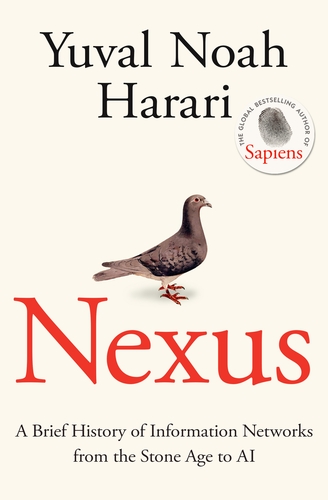
Introduction: My Journey with Harari’s Work
Following a similar pattern to my reading of Empireworld, I approached Nexus having already enjoyed Yuval Noah Harari’s other excellent books. Sapiens was arguably the first real non-fiction book I read (by choice), and in my opinion, it struck the perfect balance between density and readability. I had expected a book on “A Brief History of Humankind” to read like a textbook – too dense for quick consumption – but that wasn’t the case at all. I then went on to read Homo Deus and 21 Lessons for the 21st Century, so Nexus was inevitably high on my reading list.
Setting the Groundwork: Defining Information
To do such a comprehensive book justice, I plan to discuss my highlights from each section separately. A good place to begin is, of course, the Prologue, which sets the groundwork by seeking to define what we mean by “information” – a surprisingly difficult task.
The “Naive” View of Information
Harari introduces the “naive view,” which frames information within the context of truth-seeking, where its primary role is to represent reality. In this view, larger information networks should bring us closer to the truth. Supporters of this perspective believe that more information is always better and that progress in this direction will develop our capabilities and wisdom.
The rise of artificial intelligence raises important questions within this context. With AI’s ability to ideate and make independent decisions, we must all strive to be somewhat aware of the changes we’ll need to navigate in the near future.
The “Populist” View: Truth and Power
An alternative perspective introduced by Harari is that of “populism.” This view rejects objective truth, asserting that each individual has their own version of the truth. With this perspective, reality is directly tied to power, reducing all interactions to power struggles.
This perspective brings up intriguing questions regarding how the proliferation of AI might impact the way individuals construct and consume “truth” in our increasingly polarized world.
The “Mythical” View: Truth Through Divine Intervention
Another worldview is presented by traditional religions, which see humanity as inherently untrustworthy and power-hungry. This “mythical” perspective proposes that access to truth is only possible through divine intervention.
The success of this view is evident in the Catholic Church, arguably the most successful institution in human history. Harari highlights how religious institutions have shaped our understanding of truth, and in many ways, their teachings continue to influence how we view the world today.
Reflections: The Meaning of Information in the Age of AI
Ultimately, in this early stage of the book, I found myself reflecting on the meaning of information and what it truly means to consume it. A lack of understanding in this area has shaped history, and with the rise of AI, I understand Harari’s intent in returning to these fundamentals.
Even without explicitly drawing parallels to the coming age of AI, I imagine we will explore this further in the remainder of the book:
- The naive view suggests that powerful AI helps humanity gain more information, thus accelerating our process of truth-seeking.
- The populist view draws attention to AI’s power, as with more influence, it could manipulate an individual’s perception of the truth.
- The mythical view demonstrates the potential for AGI to position itself – or its teachings – as the path to enlightenment.
This introduction was as captivating and accessible as I have come to expect from Harari and I can’t wait to dive into Part 1.
This post is part of a series. Other posts in this series are:
